Formaldehyde grades, and how to specify board properly
Most of the timber in a modern container is not timber at all. It is board, and the grade of that board is a specification line that buyers routinely leave blank.
Ask a Lecong showroom what a wardrobe is made of and the answer is usually a material — MDF, particleboard, plywood. That answer is incomplete. The question that matters is which emission grade, because the same wardrobe exists at three prices with three different boards inside it.
This is the part of a specification that costs least to get right and most to discover later.
What the grades mean
Formaldehyde is released by the resins that bond wood particles or veneers into board. The grades describe how much.
E2 is the loosest grade and is not acceptable for export furniture in most markets. E1 is the general international standard and satisfies most requirements. E0 is tighter than E1, common in Chinese marketing and worth specifying where the budget allows. ENF is a newer and stricter Chinese class. CARB Phase 2 and the US TSCA Title VI rule are the North American regime, and F**** (F four star) is the Japanese one, the strictest in common use.
Not all of these are directly interchangeable — they use different test methods and units — which is exactly why the certificate matters more than the letter.
What it costs
The step from E2 to E1 is small, often two to four per cent on the board cost, which on a wardrobe is a couple of dollars. E1 to E0 is bigger, perhaps five to ten per cent of board cost. Across a container of case goods the whole upgrade is usually a low hundreds of dollars.
Set against that: a single rejected shipment, a recall, or a hotel client with a complaint about smell in a closed room. The economics are not close, and any factory that resists an E1 minimum is telling you what else it economises on.
The certificate to ask for
Ask for the board supplier's test report, not the furniture factory's declaration. It should name the board manufacturer, the board type and thickness, the test standard used, the date and the result. A report more than a year old is worth asking about; boards change supplier more often than furniture models do.
Then ask which board supplier will be used for your order, and write the supplier name into the specification. This is the single most effective control available, because the substitution that causes problems is not a factory lying about grade — it is a factory buying whatever board was available the week your order ran.
Checking it yourself
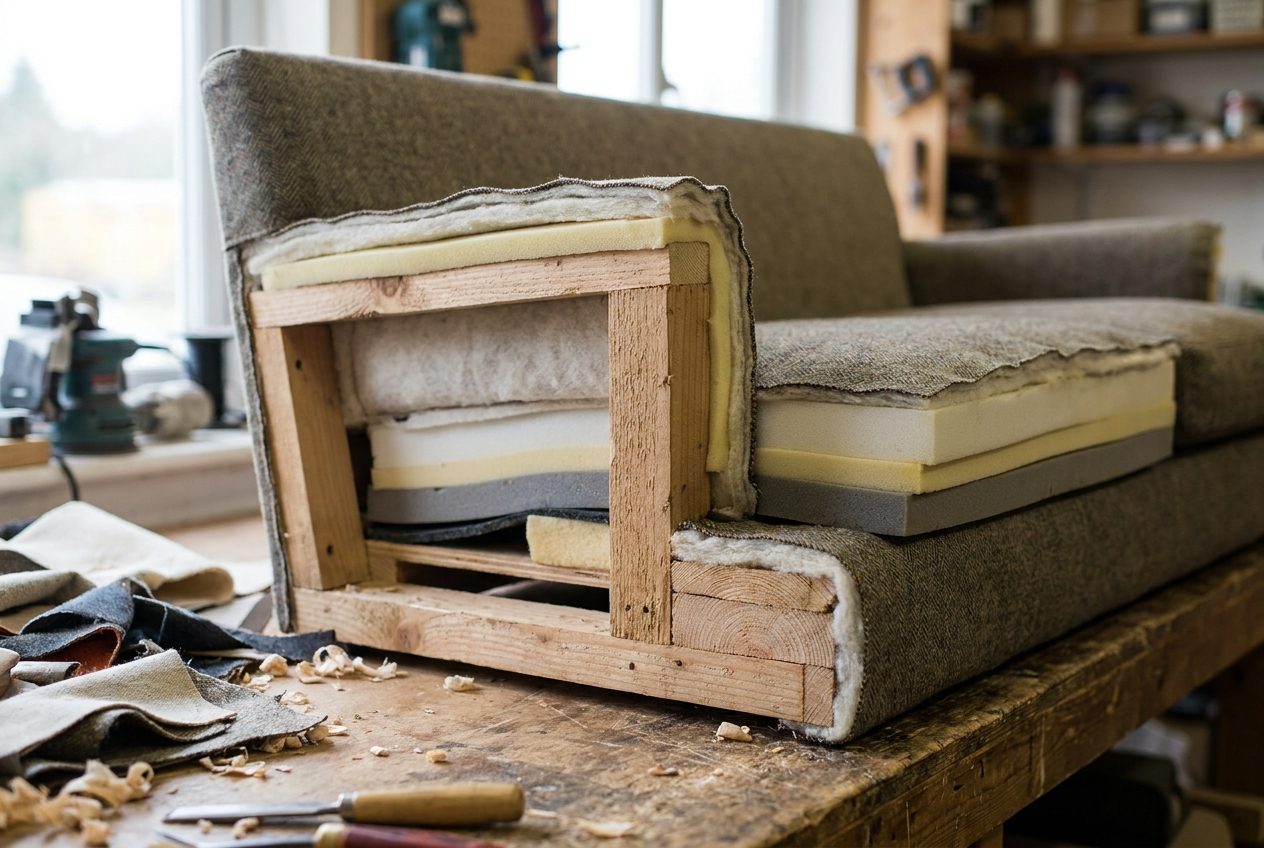
You cannot measure emissions in a showroom, but you can read the signals. Look at the cut edge of a sample: good MDF is dense and uniform with no visible voids; cheap board is coarse and crumbles under a fingernail. Look at the colour — some E0 and moisture-resistant boards are dyed green or blue by the manufacturer, which is a useful visual marker when it applies.
Smell a closed drawer or a closed wardrobe in the showroom. A sharp chemical smell in a piece that has been on display for weeks is a real signal, because emissions fall over time and anything still pungent started very high.
For a container that matters, commission a laboratory test on a production sample before the balance is paid. It costs a few hundred dollars and it is the only way to actually know.
The specification line to use
Write it like this: All panel materials to be [MDF / particleboard / plywood] from [named supplier], formaldehyde emission class E1 (or better), supported by a mill test report dated within 12 months of production, supplied with the shipping documents.
Add one more line for edges: all exposed and concealed edges to be fully banded. Unbanded internal edges emit more and absorb moisture, and they are where cheap case goods fail first — an unbanded back edge in a humid market swells, and the door stops closing eight months later.