Solid wood, veneer and board: what you are really buying
Solid wood is not automatically better and board is not automatically worse. What matters is which one suits the piece.
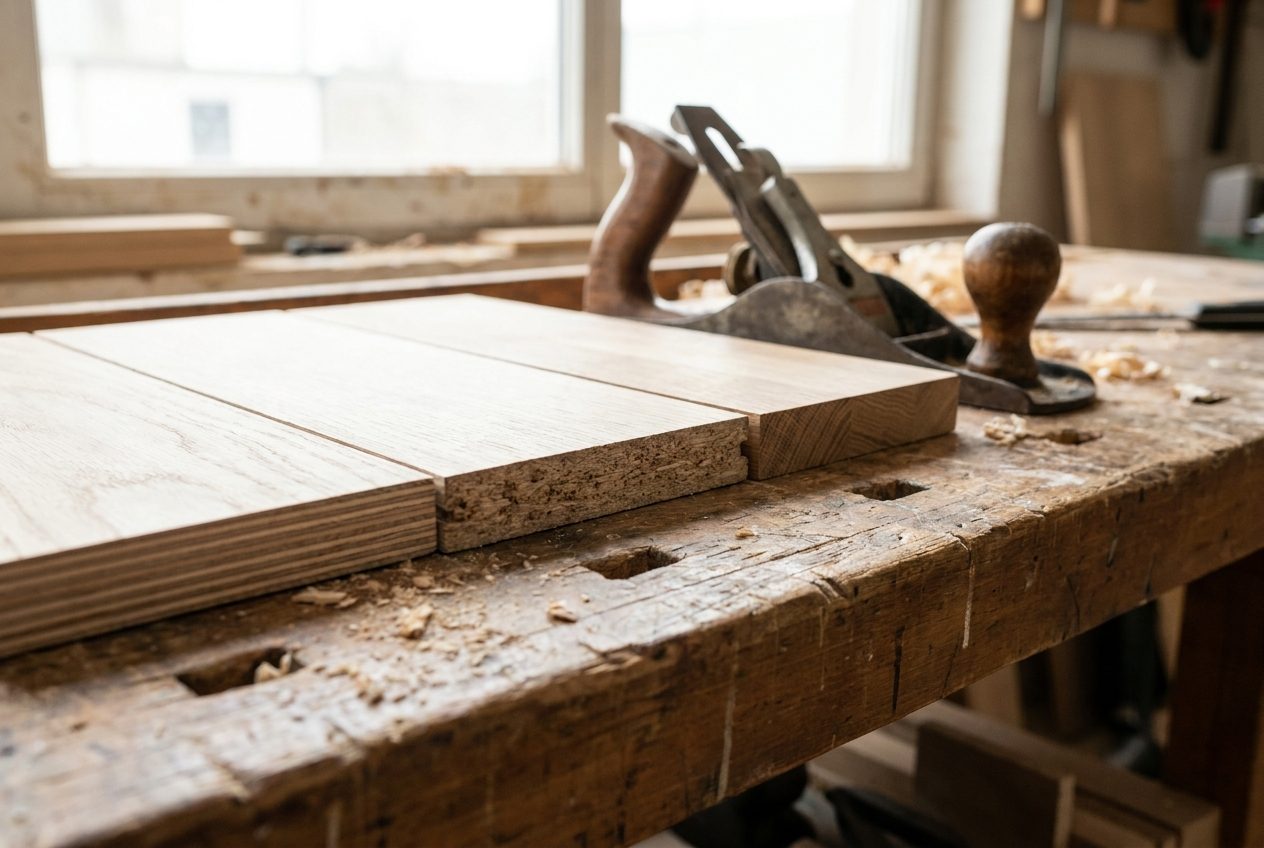
This is the area where buyers are most often sold a simple story: solid wood good, everything else a compromise. The reality is more useful than that, and knowing it makes you a better buyer and a better seller.
Solid wood
Timber cut and used as timber. It is strong, it can be repaired and refinished, and it has the depth of grain that people are actually paying for.
It also moves. Wood expands and contracts with humidity for its whole life, which is why solid wood furniture is designed with that movement in mind, using panels that float in frames rather than being fixed rigid. A piece that has been built without allowing for movement will split, and it will split in a dry heated home rather than in a humid Guangdong workshop, which is to say at your customer’s house.
This is why the kiln drying question matters more than the species question.
Veneer
A thin layer of real timber bonded to a stable core. It gets used badly often enough to have a poor reputation, which is unfair, because used well it is the correct engineering choice for a wide panel.
A large tabletop in solid wood will move. The same top in good veneer over a stable core stays flat, and the surface is genuine timber. It also allows grain matching across a panel that would be impossible in solid.
What to check: the thickness of the veneer, how the edges are treated, and whether the core is decent. A thin veneer on a poor core with a fragile edge is where the bad reputation comes from.
Plywood
Thin layers glued with the grain alternating, which makes it strong and dimensionally stable. It holds screws well and resists warping. Frequently the best choice for structural parts, drawer boxes and case backs, and it is a good sign when you see it used there.
MDF and particle board
Engineered panels. MDF is dense and uniform, which makes it excellent for painted and lacquered finishes because it has no grain to telegraph through. A high gloss lacquered door is usually better made on MDF than on solid timber.
Its weaknesses are real: it is heavy, it does not love moisture, and it holds screws less well than plywood, so fittings need designing for it. Particle board is lighter and cheaper and belongs in places that carry less load.
Choosing sensibly
- Frames and structure: solid timber or plywood.
- Wide flat panels with a wood look: good veneer over a stable core.
- Painted or high gloss surfaces: MDF, and this is not a compromise.
- Drawer boxes: plywood or solid, because they take repeated stress.
- Anywhere near water: avoid untreated board.
What to ask in the showroom
What is the carcass made of. What is the top made of. If it is veneer, over what core, and how thick. Is the timber kiln dried. What is the edge treatment. How is the back panel fixed. Every one of those is a normal question and the answers arrive readily.
The honest summary
A well made piece using board where board belongs will outlast a badly made solid wood piece, and it will do it while staying flat. The material on the specification sheet is much less important than whether the maker chose it deliberately. A supplier who explains why they used each material where they did is telling you something reassuring about the whole operation.