Adding a tile day to a Foshan trip
If your project involves floors and walls as well as furniture, you are already in the right city for both.
Foshan is known internationally for furniture, and within China it is known just as strongly for ceramics. The two industries sit in the same city, which is a convenience most visiting buyers do not realise they have until someone mentions it.
A long history
The ceramic tradition here goes back centuries, centred on Shiwan, where the Nanfeng dragon kiln has been in near continuous use for a remarkably long time. Historically the output was figures, roof decoration and vessels, and you can see the results on the roof ridges of the Ancestral Temple.
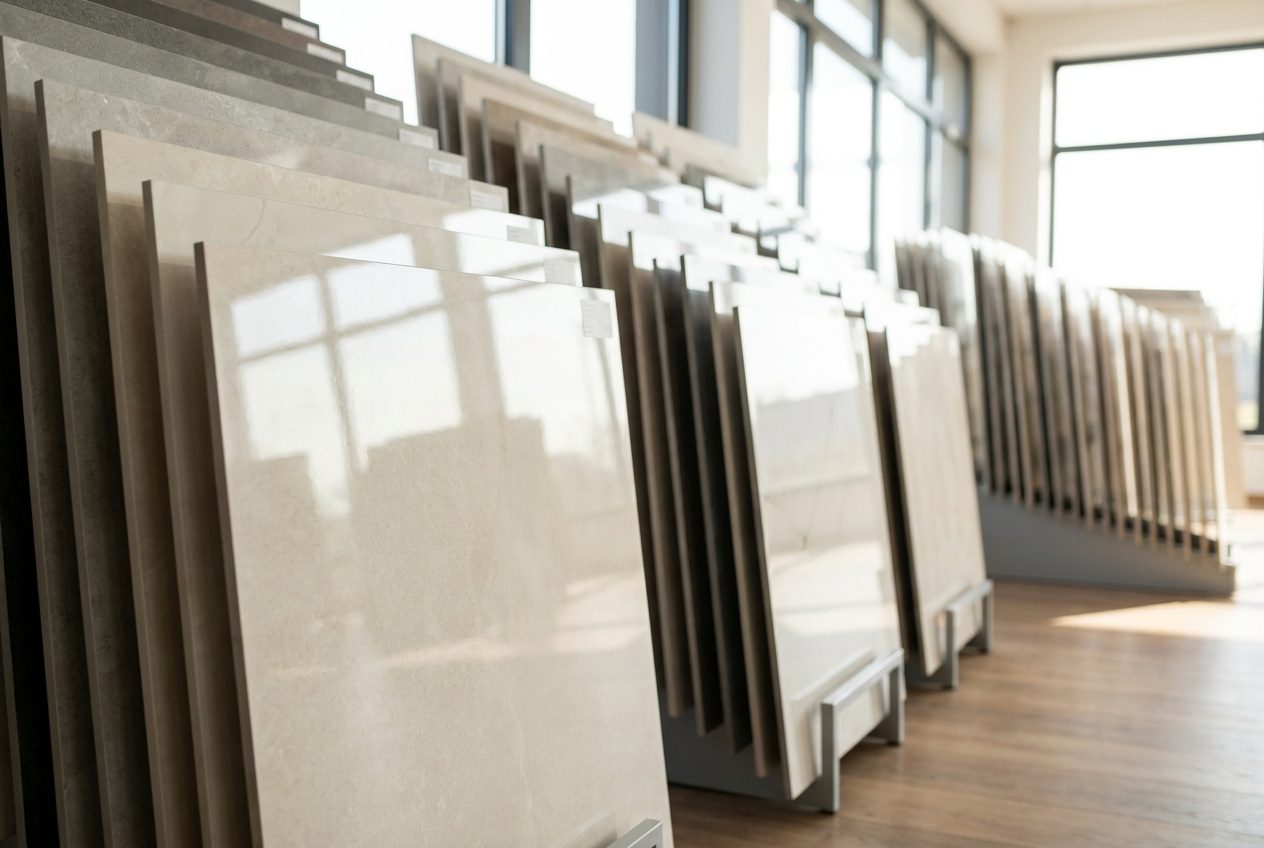
The modern industry is industrial rather than artisanal: floor and wall tiles, large format porcelain panels, and sanitaryware, produced at scale for both the domestic market and export.
Why it matters to a furniture buyer
Because a lot of the people buying furniture here are furnishing something rather than just filling a shop. A hotel project, a restaurant group, a residential development or a designer’s scheme usually involves floors and surfaces as well as furniture, and those are normally sourced separately, from another city, on another trip.
Here they are a short drive apart. Adding half a day to an existing trip is a very different proposition from arranging a separate sourcing exercise.
What the tile side offers
- Large format porcelain, which has become the dominant look in contemporary interiors.
- Wood effect and stone effect tiles, in a range and at a level of realism that surprises people who last looked at this category some years ago.
- Outdoor and anti slip ranges, relevant for hospitality and public areas.
- Sanitaryware, which pairs naturally with a hotel or apartment project.
What to check
Tiles have their own vocabulary and it is worth arriving with it. Water absorption rate, which governs where a tile can be used. Slip resistance, which matters for anywhere wet and is often specified by regulation in the destination market. Rectification, which affects how tight a grout line can be. Batch and shade variation, which is the tile equivalent of the finish drift problem in furniture and just as important.
And weight. Tiles are dense, which makes them the one product in this city where a container reaches its weight limit long before it runs out of space. That is the opposite of furniture, and mixing the two in one container needs someone who has done it before.
Combining the two in one trip
Practically, this works best as a dedicated half day rather than an afterthought, because the tile showrooms are their own district and their own conversation. Buyers who plan it in advance get a lot out of it. Buyers who try to squeeze it into a spare afternoon usually run out of time.
The mixed shipment question is the part worth taking advice on. A container of furniture is a volume problem and a container of tiles is a weight problem, and combining them is an exercise in balancing the two. It is entirely doable and it is not something to improvise at the loading bay.